
Underground cabling: Ginger HPC as an advocate for soil and construction companies
The urgency of grid expansion to drive the energy transition has become particularly evident due to the Ukraine war. While protests from residents regularly attract media attention, the potentially harmful impacts on the soil itself often go unnoticed. Ginger HPC AG, however, keeps a close eye on the effects on soil, its functions, and its properties. As a result, Ginger HPC represents the interests of future land users, such as farmers, while also providing technical assurance to construction companies on site.
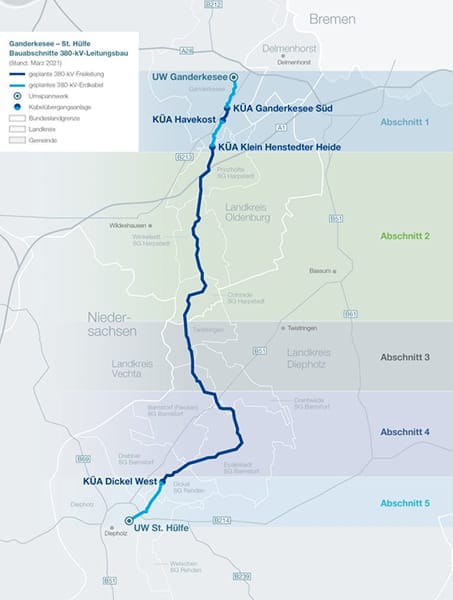
The Ginger HPC team from the Leer branch supports TenneT TSO GmbH in its project to construct a new high-voltage transmission line between the substations in Ganderkesee and St. Hülfe bei Diepholz. Electricity generated in the north is to be made available in southern and western Germany, contributing to the energy transition.
The new 380 kV line is approximately 61 kilometers long, around 13 kilometers of which consist of three underground cable sections (Fig. 1).
This is where we come in:
- Through our involvement in soil-related construction supervision, we are continuously present on site, ensuring that all soil-related aspects are properly considered.
- Throughout the entire project duration, we have carried out numerous on-site investigations required as part of the construction process.
- Our scope of services includes, for example, soil investigations in accordance with the guidelines of the Federal Soil Protection Act (BBodSchG) and LAGA, determination of grain size distribution, thermal conductivity measurements, soil water tension measurements using tensiometers, sampling with core cutters, and the installation of groundwater monitoring wells.
- With these investigations (e.g., core cutter samples), we verify, among other things, whether reinstalled soils have been properly compacted.
- In coordination with the client, we also handle communication with the responsible soil protection authority. In most cases, obtaining a building permit includes the requirement for soil-related construction supervision. Our qualified soil experts support the client from planning through implementation to final land restoration.

At a glance:
The goal of soil science-based construction supervision is the complete reclamation of the land used, so that it appears as if no construction work had taken place. This goes hand in hand with preventing harmful changes to the soil. Losses in crop yield for landowners can be significantly reduced through construction methods that minimize soil disturbance.
Of course, this involves not only the appearance of the mostly agricultural land after construction is complete, but also the proper restoration of soil functions as grassland or cropland, as well as the creation of an optimal environment for the cable route. During construction, strict separation of soil types is therefore ensured. In addition, the paths used by construction machinery are specifically protected against compaction damage.
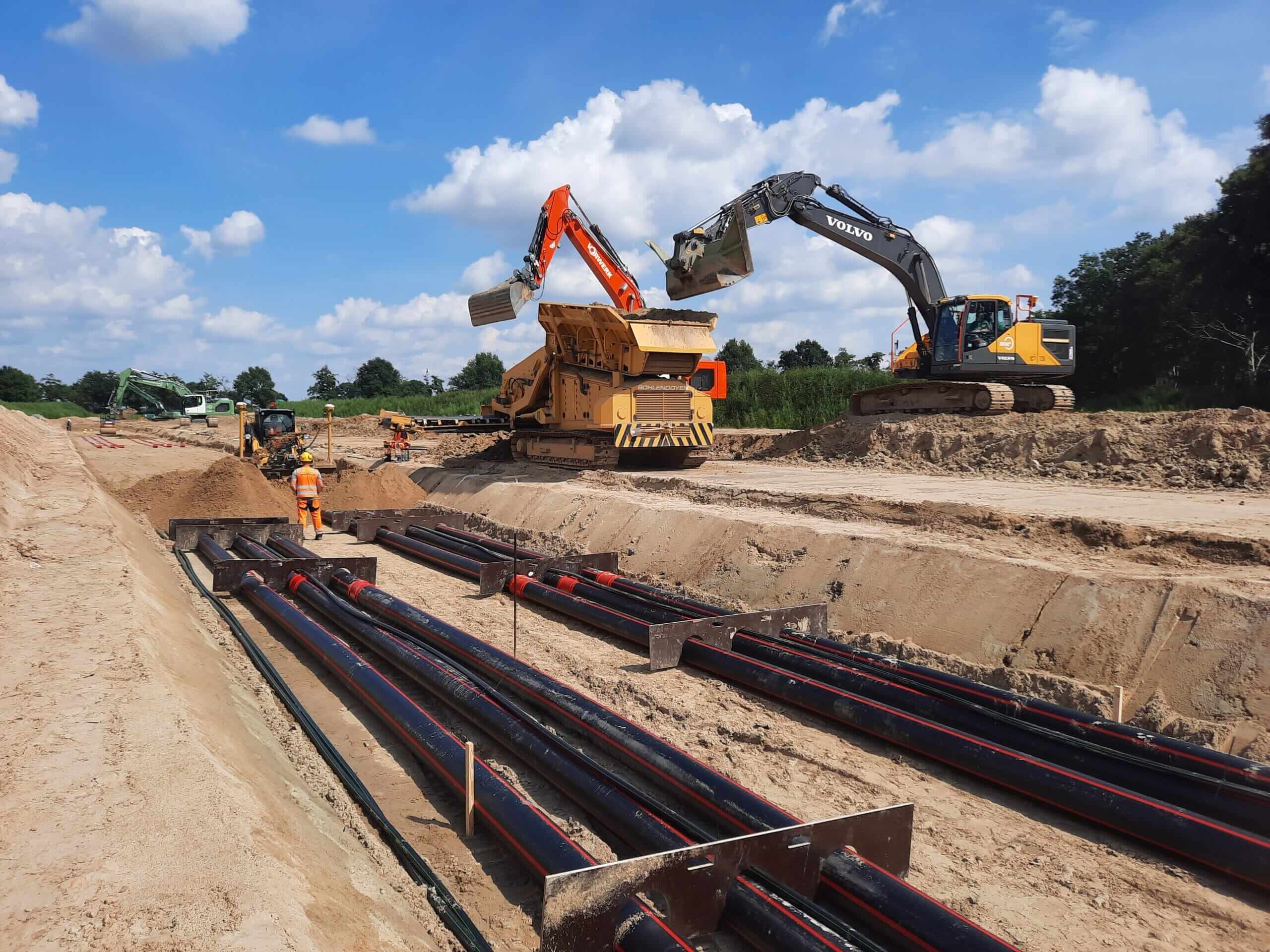
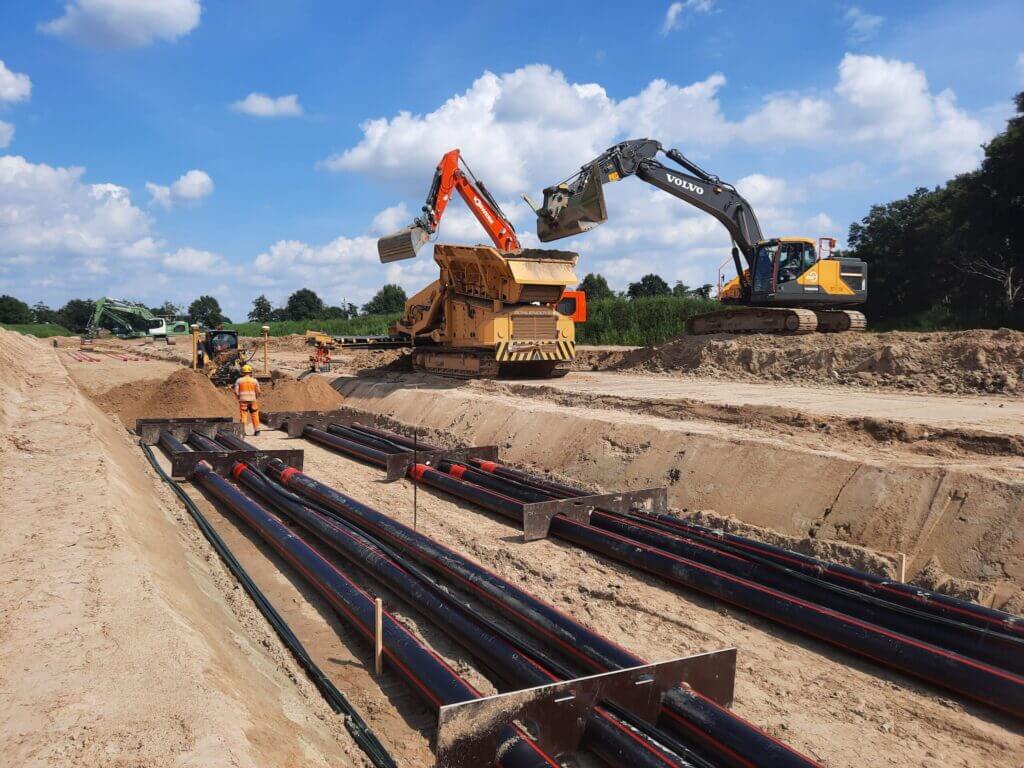
To lay the underground cables, the topsoil is first carefully removed and deposited in a pile running parallel to the cable trench, to the side of the construction site. The underlying subsoil layers are then excavated separately and also stored to the side, but in separate piles. In the next step, the welded-together conduit pipes are laid along the cable trench, and the trench is backfilled while maintaining the original sequence and thickness of the soil layers. During backfilling, the soil is screened using a screening machine to remove large stones that could have damaged the conduit pipes (Fig. 2).
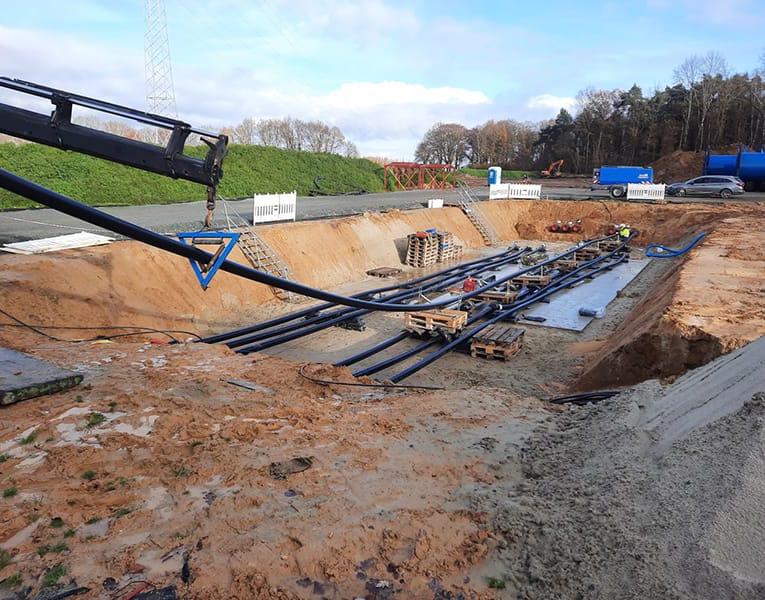
After the cable trench has been backfilled, the power cables are unrolled from a cable drum and pulled into the conduit. The ends of the custom-cut cables are joined in a joint pit (Fig. 3), creating an uninterrupted power line.
Sometimes, as a soil science construction supervisor, one must stand in the way of the schedule and make decisions to protect the soil that lead to the displeasure of the construction companies. Nevertheless, we remain steadfast and defend the soil, because every construction project carries the risk of harmful soil changes, such as harmful compaction.
During longer construction projects, such as the one in Ganderkesee, a variety of weather conditions—both favorable and unfavorable—are encountered over the course of the project. To preserve natural soil functions despite adverse conditions, the risk of harmful compaction can be significantly reduced through planning measures taken before construction begins and through consultation during the project. The preservation of natural soil functions is the top priority.
The soil must also be protected during construction work. This is achieved by training equipment operators on-site and by selecting the right equipment. People on the construction site are instructed by the soil science construction supervisor and made aware of the importance of treating the soil with care. In this way, much damage can be prevented in advance. If problems do arise, practical solutions are found and implemented on-site. This helps reduce follow-up costs for reclamation measures.
We therefore act, on the one hand, as advocates for farmers and other landowners, and, on the other hand, in an advisory capacity for the construction companies working on-site.
More success stories




Why work with us?
More than 75 years of experience
Since 1948, Ginger HPC has combined expertise and precision in environmental and engineering projects – ensuring reliable solutions that stand the test of time.
Strong international network
With offices across Europe, as part of the Ginger Group and as a founding member of the Inogen Alliance, we bring global insights and local expertise to every project.
Award-winning sustainability
From international certifications to industry awards, our achievements reflect engineering precision, high standards, and a continuous drive for innovation.
Our Service Areas
No child pages found for the selected parent.
Got a project in mind?
We have the solution.